
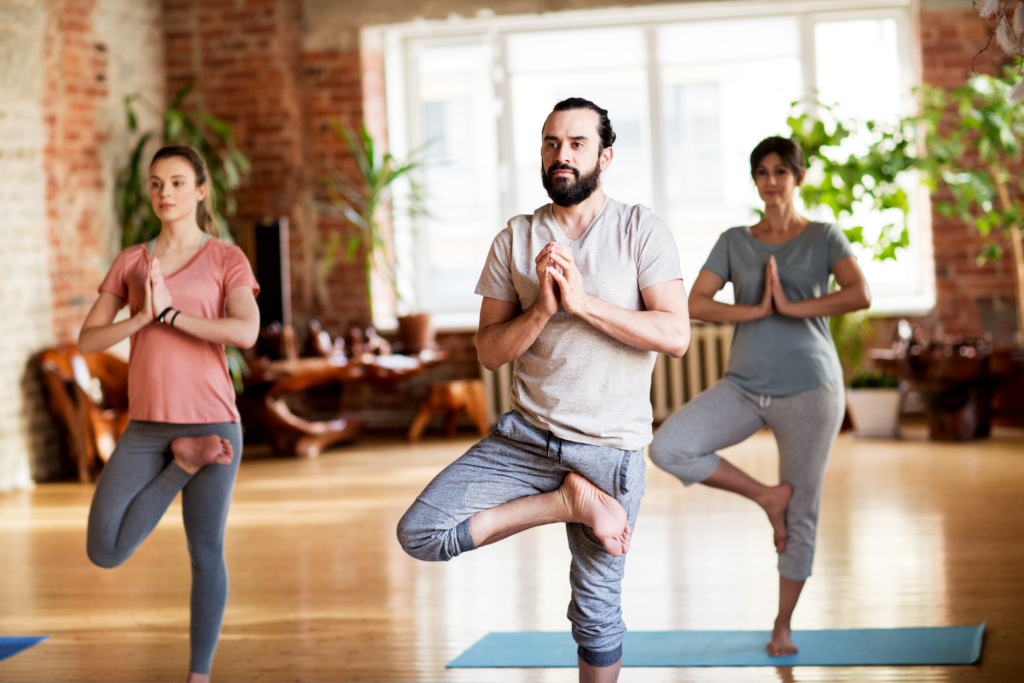
Stress is prevalent in our daily lives, particularly from our work, whether dealing with delayed trains or traffic jams or performing our deadline defined work, the factor is stress! The ancient medicine of Ayurveda presents us with yoga and its asanas, pranayama which I already covered. The asanas – yoga poses help us maintain our health and wellbeing. In addition the spiritual aspect plays a role.
Let’s take a quick look at the harm stress can cause us before referring back to the relief provided by practicing yoga asanas. Our breathing pattern in a stress situation sends a message to the brain on a certain reaction. Cortisol, the stress hormone, is secreted by the adrenal gland to deal with fear or stress with the ‘fight or flight response’. Essentially, cortisol provides health solutions, regulating the inflammatory response to stress, our immune system, controlling glucose and insulin release and regulating our blood pressure. (In fact, cortisol is even manufactured in a laboratory and is then known as hydrocortisone to treat inflammation and allergies – remembering it from my teens in the form of a mustard-yellow cream to treat eczema on my hands.)
However, an excess of a good thing leads to malfunctions which start to occur and excess cortisol in the body may produce the following unwelcome symptoms amongst which are: Hyperglycaemia (blood sugar imbalances), decreased bone density, decreased muscle tissue, higher blood pressure, memory deficit or brain fog, increased abdominal fat, lower immunity and a suppressed thyroid function.
Rather than reacting with the fight or flight response to a stress situation, it would be preferable to make lifestyle changes to manage your stress in the first place. This applies particularly to people with a tendency to increased abdominal fat as there is the added risk of heart attacks, strokes or higher LDL (bad cholesterol) and lower HDL (good cholesterol).
Some of the well known and best stress management therapies are of course, relaxing, listening to music, dance, going for a walk in the forest etc. It depends on each individual from where you find nutrition for your soul.
According to studies, the following are of considerable importance in managing or preventing stress:
Yoga, Pranayama – breathing exercises and Earthing.
Pranayama and Earthing, I have already covered.
Concerning the physical benefit from practicing asanas in yoga, it is clear – increased flexibility and strength which in turn lowers blood pressure. Regular practice of yoga also provides benefits to mental health or stress relief.
Increased spirituality is also a factor. Just a quick look at religion and spirituality. Whether praying – in Christianity, Islam, Judaism, Buddhism, Hinduism or Sikhism, our cortisol – stress hormone – is lowered. We accept, are grateful and appreciative of all creation on Earth, we show love and trust in God when overcoming grief, just to name one example of many. We trust in God’s guidance and only ask for ‘goodness’ knowing He will know how to guide us, how to manifest this “goodness.” By turning to God – the Creator- the Universe, we communicate. We communicate through our soul when praying. Is our soul our Dan Tian in Chinese Medicine which houses our original life energy? I’ll look more in depth at this topic later.
Meditate or pray to find the small seed which will lift us and let us grow, with trust and love and faith in God – the Creator – the Universe – we find answers to our prayers, have small signs and synchronicities placed on our path to guide us to the next stage. Just working on that and the same process will repeat itself with other signs and synchronicities.
Back to the ancients and the philosophical truth which has worked effectively over centuries and centuries. In the science of Ayurveda the soul is the Atma and the uppermost goal in Ayurveda is Prakriti, which means to live in awareness and harmony with your soul.
To learn more about Ayurveda’s approach on the subject, we should turn to the source of all Vedic knowledge. The ancient texts of Ayurveda are to be found in the Caraka Samhita (चरक संहिता ) otherwise written as Charak Samhita, the original Ayurveda reference source written in Sanskrit written some 3,000 years ago by Acharya Agnivesh, updated some 2,000 years ago by Acharya Charak and finally in the fourth century Dridhabala added 41 chapters to complete the work referred to by all Ayurvedic scholars to this day.
Following the Persian era in India when there was still a flourishing of Ayurveda, in more recent times during the British era, teachers and scholars did not add to the work as this was the period during which Western medicine took absolute priority. Happily Ayurveda survived!
Especially in these times we now live, humanity is hugely in need of a holistic approach to health. Dr Gopal Basisht, MD together with Ayurvedic scholars in India have taken on this task in 2013 to update the Charak Samhita which as a secondary goal aims to present Ayurveda as one of the most effective methods of preventative medicine to practitioners and researchers on a world wide basis. Professor P.V. Sharma is translating this great work into English. For further information on the work:
https://www.carakasamhitaonline.com/index.php?title=Charak_Samhita_New_Edition_(Wiki)_Project
According to the Charak Samhita, prakriti “pra” means principle and“kriti” creation, so prakriti means bridging the gap between body (mortal) and soul (immortal) during your life. Upon death the physical body returns to nature, to the soil (the native Americans understand that we return to the sea from the accountability of the water percentage of the human body) and the soul returns to God -our creator- the universe- to its original source, it is immortal and non-changing. The soul is our eternal consciousness.
Any imbalance in Ayurveda is considered a block between the mortal and immortal, in other words, consciousness expressing itself as matter and matter forgetting this essential connection to consciousness. This imbalance manifests itself in the body when cells, organs, organ systems start to function in isolation without their natural connection to the soul and coordination with the “whole”. In nature this happens when humans pollute the air, water and land, their actions lack connection and coordination with the “whole.”
Prakriti defines everything from a geographical region to an individual plant just at the two-leaf stage. You can heal a sick plant or not, depending not alone on vitamins, good water or soil but your feeling, ‘communication’, your energy will contribute to its healing. Just think of when you spend some weeks in any location, you will have a feeling of whether or not this place is beneficial to you. Even a question of architecture can be aligned with your soul or weigh heavily on it.
An Ayurvedic practitioner will define a patient’s deha prakriti, according to the predominant dosha present in the individual at the time of conception.
The body constitution will be assessed as dominance in the Vata, Pitta or Kapha dosha. Each dosha is accompanied by dosha specific health tendencies which the individual may develop. In addition, the time of day, age, parts of our body, seasons, nature, food, herbs are also dosha defined. For example, as small children we are very Kapha and as elderly people we are Vata, hence Vata health disorders may manifest themselves in latter years even though the individual has a Pitta dosha dominance, for example.
Each individual has a dominance in a particular dosha, however nobody will be 100% one dosha or even have a total equilibrium of 33% each dosha. As a broad generalisation, a Vata dominance will be manifested in dry skin, dry hair, lean bodied individuals prone to nervous disease, fatigue and insomnia; a Pitta dominance will be manifested as strong personalities, prone to inflammatory ailments such as ulcers and a loss of hair pigmentation and a Kapha dominance will be manifested in heavy bones, muscle and fat, susceptibility to respiratory and obesity related disease. We all have a dominance but also elements of the other two doshas in our constitution and the Ayurvedic practitioner will base his diagnosis on this evidence.
Here my focus is on the health benefits provided by various yoga asanas. Scientific studies have shown yoga practice to be effective in lowering stress levels.
https://www.ncbi.nlm.nih.gov/pmc/articles/PMC5433116/
https://www.ncbi.nlm.nih.gov/pmc/articles/PMC4784068/
The Tree Pose or Vrikshasana
- Like a tree, standing on one leg with the whole foot as the tree’s roots to provide balance, flexibility, strength and concentration. Standing on the foot including on your five toes provides a balance and strengthens our bones, especially in our hips and legs.
- The second leg held at the groin by the foot.
- When our hands are raised above our head, the spine is stretched, taking care our body is in alignment, promoting the smooth flow of prana, the diaphragm is open to deep breathing, the lungs can fill to capacity enabling improved breathing.
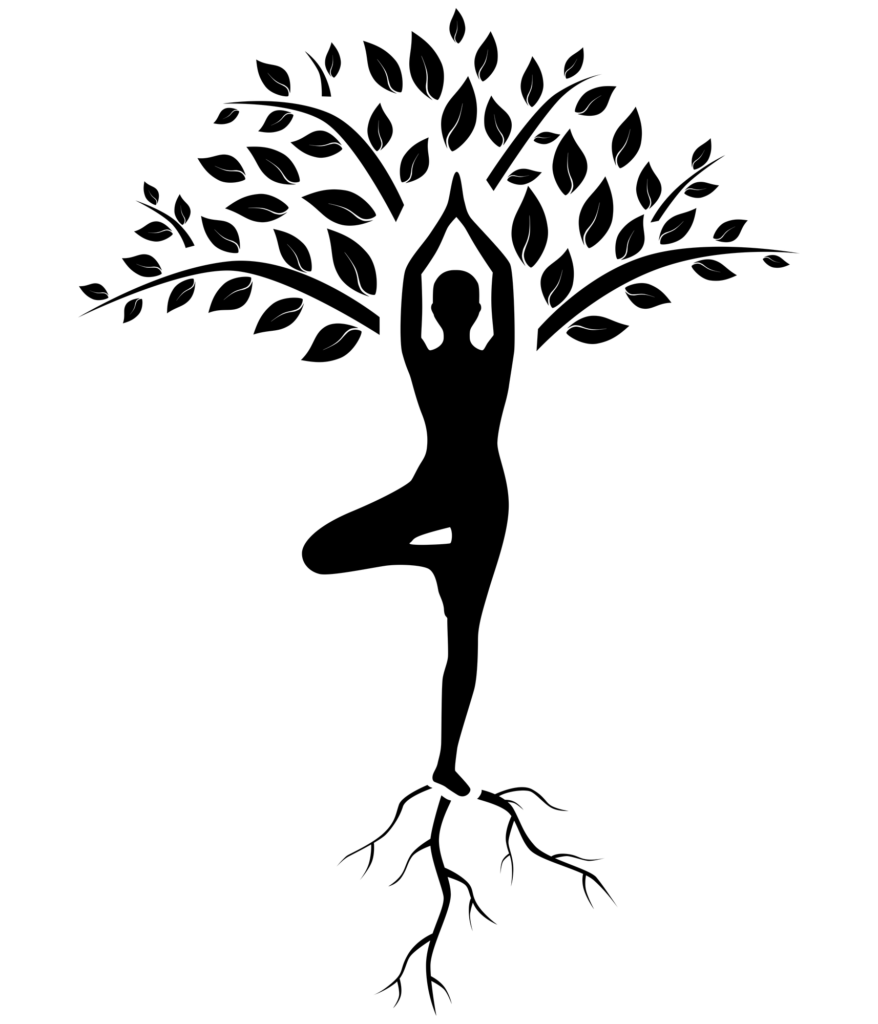
The position is energising and de-stressing, energy flow – prana – is increased since most muscles and joints are in use in this asana. Breath is regulated and so enables calmness of the mind. The benefits occur as with grounding. Most important is the grounding in the feet as the exercise is performed to reflect the movement of a real tree, including swaying.
By practicing vrikshasana balance is increased and danger of falling considerably decreased. This is of particular interest to more elderly participants who may be more concerned about falls. It strengthens all the muscles of the standing leg, ankle, calf and quadriceps (the 4 large muscles on the front of the thigh.)
When we additionally raise our arms, we stretch our shoulders, chest and spine which is vital to our wellbeing. Deeper breathing into the diaphragm enables full use of our lungs. An alignment of our shoulders with the hips and foot are essential to stability in balancing. Alignment allows prana to flow smoothly throughout our body, posture is improved and balance improved.
As mentioned there are more advanced versions of this asana with swaying, just like a tree sways in the wind, but this is for more a more advanced level once your leg muscles have strengthened.
As we practice the Vrikshasana we focus our gaze, this also maintains our balance and helps us to be focussed. Our mind will find equilibrium and connection to our environment.
The Cat Pose – Marjaryasana and The Cow Pose – Bitlasana
The Cat and Cow Pose are frequently practiced together since the benefits are the same.
- From a tabletop position, the Cat Pose stretches with an arched back
- From a tabletop position, the Cow Pose with a drooped back (imagine the cow’s udder hanging down)
Both release tension, anxiety and stress. They also strengthen the arms, stretch the back and help digestion. The cat pose can be soothing and relaxing, precisely this good feeling is why cats do this movement! It benefits the abdominal area, aiding digestion and encouraging blood flow which also increases the flow of nutrients.
The Cow Pose is also a soothing movement and the movement of the back enhances the spine and alleviates back pain.
In Yoga there are groups of asanas recommended for specific health issues. My first encounter with yoga was for menstruation, painful periods. Let’s start with it:
MENSTRUAL PAIN :
The Archer’s pose – Akarna Dhanurasana
- Sit straight with your legs stretched out in front, stretch your back with a straight spine
- Inhale, bend over to touch your toes, bring the left foot towards the left ear, keeping your right forearm touching the toes of the right foot
- Hold for 15-30 seconds
- Release and repeat with the right foot, right ear and holding the left foot with the left hand.
In addition to easing menstrual pain, this asana builds core strength, stretches and strengthens legs, increasing hip mobility and expands the lungs.
Bound Angle Pose – Baddha Konasana
- Inhale and sit with your legs stretched out and spine straight
- Bring your feet towards your groin and place your hands on the ankles to help
- Let your knees fall gently to each side
- Press the soles of the feet together concentrating on the heels touching
- Bring your feet closer to your groin, keeping them on the floor
In addition to easing menstrual pain, it builds inner thigh and groin flexibility, lowers blood pressure and reduces anxiety.
This asana also provides immense relief from the “sitting on an office chair 8 hours a day” syndrome, the inner thighs will thank you for practicing this asana!
KNEE PAIN
Although these asanas should not be practiced if you have an actual injury to your knee, leg or back (requiring medical intervention), they are recommended for adapting your body to normal with relieving stretches after sitting for hours on chairs which causes a tightening of the hips.
The Easy Pose – Sukhasana
It is the simple crossed leg position used for children in school gathered in a large room without sufficient chairs.
The Fish out of Hero Pose – Matsyendra Virasana
Flexes the knees, stretches the quadriceps, neck and shoulders, strengthens the back, decreases tension and anxiety.
- From a kneeling position, widen your knees apart and sit down between your knees
- Place your palms on the soles of your feet and lean back, placing your forearms and elbows on the mat and your face looking at the ceiling. Hold for 30 seconds.
The Hero Pose – Virasana
For healthy knees and stretching of the quadriceps
- From a tabletop position, standing on your hands and knees position, sit back to a kneeling position.
- From a kneeling position, widen your knees apart and sit down between your knees, remain here for 30 seconds.
The Frog Pose – Mandukasana
Stretches the hips and groin region, stretches the leg muscles, strengthens the back and benefits the knees.
- Start from a kneeling position, move into a tabletop position aligning the hands directly below the shoulders.
- Open your legs to a 90 degree angle with inside of your thighs and feet on the mat
- Lower your forearms to the mat and inhale, exhale
- Lengthen the spine and feel the spine stretching
- To exit the pose return to tabletop position
The Half Lotus Pose – Ardha Padmasana
Lengthens the spine, opens the hips, improves posture, prevents knee pain and promotes focus
- Sitting with the legs stretched out and feet flexed, bring one leg gently placing the heel on the upper part of the opposite thigh
- Bend the other leg and place it as with crossed legs.
- Release the pose, stretch out legs and repeat with the other leg.
The Half Bound Lotus – Standing position – Ardha Baddha Padmottanasana
Relieves arthritis, provides a healthy posture, helps digestion and circulation, stretches the quadriceps and provides for healthy knees.
- Starting from a standing position, mountain pose
- Balance on your entire left foot, bring the right leg across your body, bent at the knee
- Square your hips and drop the right knee, feel the stretch in your hip and leg
- With right arm reach behind your back and weave through to hold your raised foot
- Raise your left arm to heart centre
- Lower your left arm and abdomen forward with left arm supporting the standing leg
And finally to relax:
The Upward Salute Pose – Urdhva Hastasana
Standing position, normally beginning of the sun salutation
- Stand in mountain pose, root you feet including toes to the mat
- On an inhale raise your stretched arms above your head
- Bring your palms to heart centre (prayer position), lower your shoulder blades, lower your ribs towards your belly button
- Breathe in this position for 5 minutes
This was an introduction to asanas and their health benefits to show you how a combination of asanas can work together to alleviate one health ailment.
Not only are asanas healthy but give you a “great feeling” and coordination of body and spirit, a quality beyond the normal fitness routine. Yoga asanas- like Qigong and Tai Chi – are energetic and spiritual healing exercises enabling a smooth flow of prana through the nadis– energy channels – like the Meridians in Chinese Medicine – running through our body passing through the chakras – the energy junctions.
Yoga offers asanas for beginners, intermediate and advanced, enabling beginners not to be nervous about starting and yet still reaping some benefit. The intermediate students can enjoy a greater spectrum of asanas with more far reaching benefits. The advanced level offers complex asanas requiring a higher degree of balance and flexibility, a challenge for those who would like to reach it however not essential for those practicing the intermediate stage which fulfils all the fundamental health and spiritual aims of performing yoga.
Yoga purifies and cultivates prana, providing an emotional and energetic balance. It provides a distancing from negative thought patterns, calm energy and opens up a self exploration of the subtle body.