

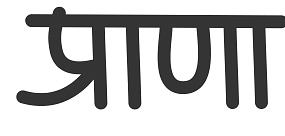
Pranayama comprises two Sanskrit words : “prana” and “yama”. Prana is the life force energy which flows through all living beings and yama means to control, regulate or expand.
Prana enters the body through breath, via the lungs spreading throughout the body. It forms an aura or subtle body – an electromagnetic field – around the body known as the pranamaya kosha, the second of the five subtle body layers, think of them as invisible envelopes around the body. Inside the body prana flows through channels known as “nadis” and passes through energy centres we known as “chakras”.
In Ayurveda, prana resides in five specific locations in the body, these being : prana, apana, samana, udana and vyana. Of course, they are all essentially “prana” but these names refer to their location. Similarly in Chinese Medicine we have Jing, Qi and Shen which are all essentially Qi.
Prana Vayu: Prana Vayu is located in the abdomen and governs “Agni” appetite, respiration and the organs of elimination (Note in Chinese Medicine, the centre of Qi is also located in the abdomen)
Apana Vayu: Apana Vayu is located in the pelvic region, controls the elimination waste procedure passing through the intestines, bladder and genitals.
Samana Vayu: Samana Vayu is located in the head, controls the ears, eyes and muscles for respiration through the nose.
Udana Vayu: Udana Vayu is located in the throat region, produces the voice and speech
Vyana Vayu : Vyana Vayu is located in the small of the back, governs blood flow in the chest and lungs
The energy centres or “chakras” activate prana to flow up the spinal column. Similarly in Chinese Medicine the Du Mai or governing vessel through which qi flows up the spinal column. The quantity and quality of prana flow governs how we feel.
If the prana is flowing continuously, smoothly and steadily, the mind remains calm, positive and enthusiastic. However a neglected, albeit unintentional, focus on the way we breathe causes the nadis and chakras to be partially or fully blocked. Pranic flow will then be irregular and broken and this gives rise to increased negative emotions such as worry, fear, uncertainty, tension and conflict. This in turn affects our whole wellbeing as sickness shows up in our prana, long before we experience sickness physically.
This is where we look to “pranayama”, a means of controlling our life force energy for our wellbeing.
Pranayama is a health breathing exercise carried out in combination with a specific pose “asana”, frequently the Padmasana (lotus pose) with crossed legs, the way most people associate as the yogapose, and focused breathing.
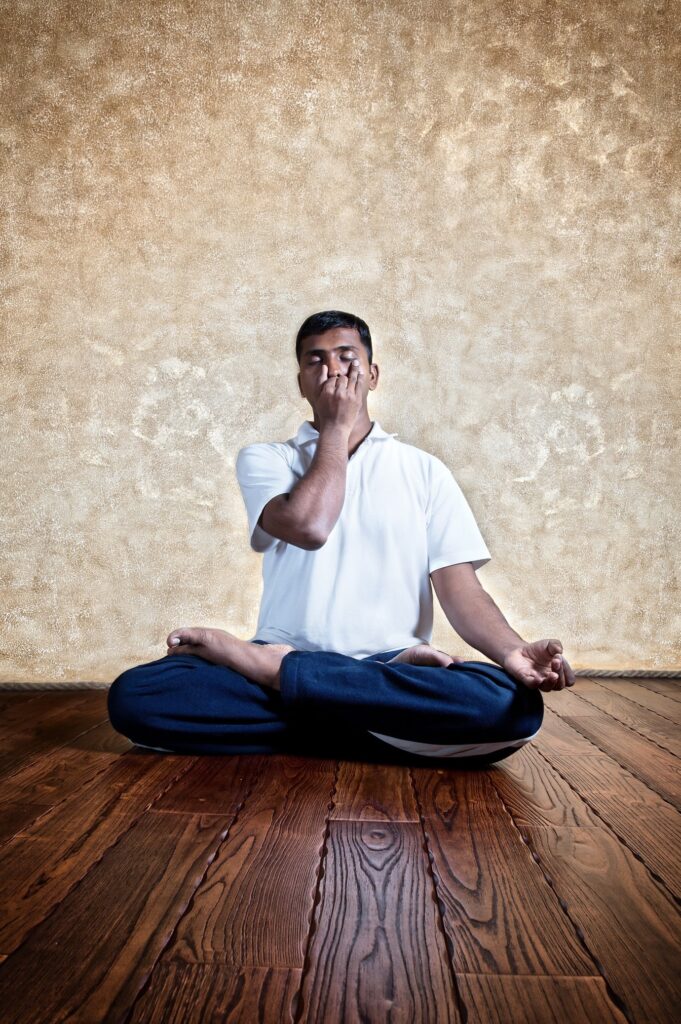
Most pranayama practices involve slow and deep breathing, enabling increased oxygen absorption for our brain and body. The practice reinforces the connection between body and mind, the essence of wellbeing in Ayurveda. It relaxes us, improves physical, mental and emotional well-being. “Pranayama” is more than a relaxation process, it has well-documented health benefits.
Why do we need breathing technique exercises when we breathe automatically anyway, what factors affect the effectiveness of our breathing, you may ask.
Stress can be anything we experience on a daily basis which causes us anxiety, fear of failure, not fulfilling expectations.
In these times we experience stress regularly in our deadline orientated world. Competitive should be a positive concept, however it has an inherent survival aspect accompanied by an likely intolerance of our possible failure, causing fear and as a result activating the sympathetic part of our nervous system.
For example, giving a presentation in front of a large number of people, a project deadline to meet with unpredictable external factors, not to mention the numerous stress factors of the last few years! Hence our breathing is often shallow and short extending just to the upper lobes of the lungs. We live a hectic pace of life and when we run for the tram or train to avoid being late and are not in the best condition of fitness, we pant!

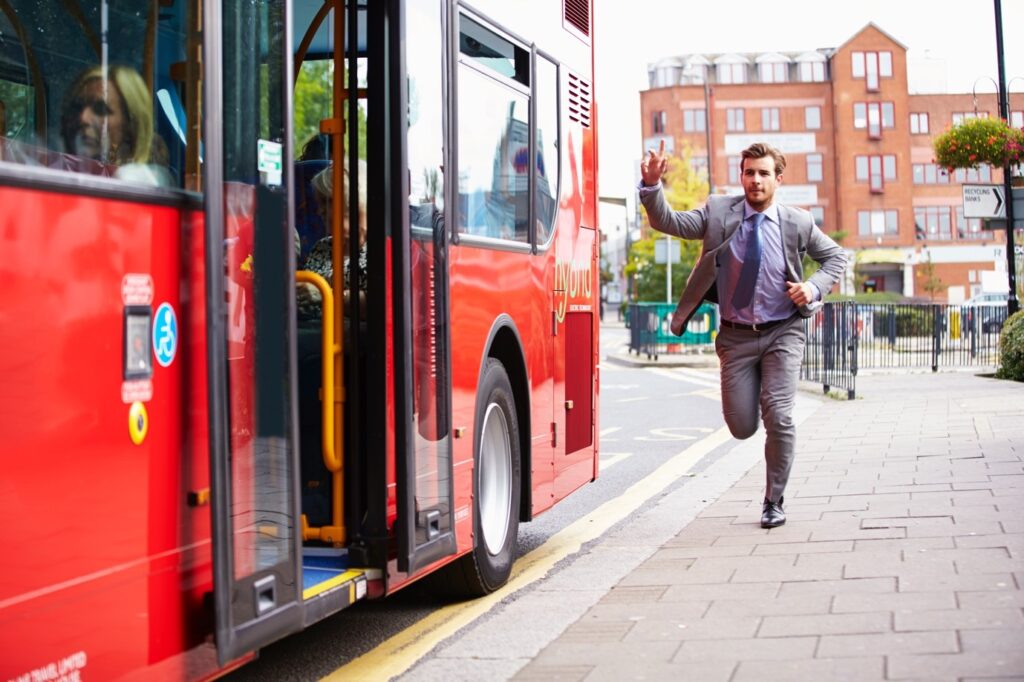
Shallow and rapid breathing is physiologically only appropriate for situation of extreme fear! Our body knows the sequence how to activate our blood in response to stress. First, stress hormones are triggered, then blood is pushed away from the organs making us appear pale and platelets take on a sticky consistency to protect us from bleeding excessively if attacked. The muscles become tense and we may tremble as heart rate, blood pressure and breathing all increase their pace to keep us alert.
In our daily life, however, it is not healthy to be in a constant state of alert! The sympathetic part of our nervous system has taken over whereas it should only act as our body’s crisis management tool.
We are aware that smooth and deep breathing is an indicator of longevity and good health. It suffices to compare our own breath to that of a dog! A dog has a shallow and short breath and his lifespan is considerably shorter to our own.
Most pranayama exercises promote deep, slow breathing which enable the lungs to receive sufficient oxygen. Breathing through the nose has the added benefit of producing nitric oxide (NO). Nitric oxide delivers oxygen deep into the seven layers of our tissues or “dhatus” and heals. In addition, nitric oxide maintains healthy weight, boosts immunity, increases the sexual function and elevates the mood.
The dhatus in Ayurveda are the sustaining factors in our body: rasa (plasma), rakta (blood), manas (muscle), meda (fat), asthi (bones), majja (nerves) and shukra (the male and female reproductive organs).
In order to be aware of potential healing qualities of practicing pranayama, it suffices to try the following exercise. The perfect starting point:
DIRGA PRANAYAMA – Three part breath – a beginners’ pranayama
Three part refers to filling three different parts of your abdomen with breath! It is ideal for beginners as it provides the experience of awareness and use of your whole lung volume. It was my first encounter with pranayama and I recommend it wholeheartedly.
- Lie down comfortably on your back
- Inhale, exhale deeply through your nose, comfortably. Focus on the breath.
- Breathe deeply, inhale into your belly, watch it expand
- When the belly is full, draw more breath into your rib cage, causing the ribs to widen apart
- Finally draw in some more breath into your chest up to the collarbone
- Begin to exhale slowly starting from your upper chest
- Then release breath from the rib cage area, allowing the ribs to slide closer together
- Finally release the air from within your belly drawing the navel towards the spine
Repeat 5-10 times
- Pay attention not to overstrain your breath, breathe to full capacity naturally and the exercise will be of benefit in any case
- In case of dizziness return to your normal breathing
The above exercise DIRGA PRANAYAMA is preventatively beneficial for the lungs (and the heart, which is located in the area of focused exercise).
NADI SHODHANA PRANAYAMA – The Alternate Nostril pranayama, also known as ANULOM VILOM
This is most beneficial for grounding the Vata dosha.
The mechanism by which alternate nostril breathing may be reducing the blood pressure is complex. The change is possibly related to improved parasympathetic control over the cardio-vascular system.
- Sit in a comfortable place, cross your legs if possible.
- Sit upright and close your eyes.
- Using the right hand, close the right nostril with the right thumb.
- Inhale through the left nostril.
- Then close the left nostril with the 3rd and 4th fingers.
- Inhale through the right nostril.
- Then close the right nostril by pressing with the right thumb.
- Last, exhale through the left nostril.
I find the Nadi Shodhana Pranayama beneficial, although there is a more advanced version which involves alternate nostril breathing plus breath retention called, for reference, the Surya Bhedi Pranayama.
Just check the scientific evidence behind the positive effects from performing pranayama:
https://www.ncbi.nlm.nih.gov/pmc/articles/PMC3628802/
Can pranayama alleviate already present respiratory ailments?
Since breathing directly concerns our lungs, let’s look at a pranayama notably beneficial to our lungs.
Healthy lungs are characterised by an ideal exchange of gases in the process of respiration to the bloodstream. Oxygen enters the blood through the lungs (inhalation) and Carbon Dioxide leaves the blood through our lungs (exhalation).
Imbalances in this process may cause disruption to this smooth respiratory function manifesting themselves in breathing difficulties which may be related to or give rise to asthma, bronchitis, COPD, pneumonia or influenza.
By practicing pranayama to resolve respiratory disorders, we access the full capacity and depth of our lungs. Deep, smooth and slow breathing helps us to attain the maximum healing benefits of breath. Deep, intentional breathing increases the pranic flow, the flow of prana together with nitric oxide enables our body to repair and heal itself. Once we are aware of this breathing technique, it becomes second nature.
So, a very effective Pranayama exercise in relieving respiratory ailments is the:
UJJAYI PRANAYAMA – ocean pranayama, also known as the victorious breathing exercise
Initially performed in the Padmasana – lotus position, later another asana may be adopted which increases the breathing benefits obtained. A longer breath is the result.
- Establish a deep breathing inhaling in to the diaphragm and exhaling deeply, both without straining.
- Inhale and watch and feel your belly rise, placing one hand here.
- Exhale and watch and feel your belly return to its place.
- Repeat the inhale and exhale exercise with a long breath into your chest.
- Feel your chest expand with the inhale and return to its place with the exhale.
- Now try to establish a slight closure of the glottis and feel you are breathing through a small opening in the throat. You use the same muscles as you do for whispering. To learn the process, you can start with an open mouth, then repeat with a closed mouth and you have mastered the technique.
- All the breathing occurs through the nose.
- Feel the breath enter your chest through your throat with the ribs spreading and chest expanding.
- Feel the breath exit your chest through your throat with the ribs and chest returning to their place.
- As the breath passes consciously through your throat, you will automatically emit a small sound resembling the waves of the sea, hence the name ocean pranayama.
Some more scientific evidence:
https://www.ncbi.nlm.nih.gov/pmc/articles/PMC3655580/
BHRAMARI PRANAYAMA – humming bee breath
Bhramari Pranayama is known to have a calming effect and alleviate hypertension, insomnia and anxiety, all of which are the major underlying causes of Tinnitus. Bhramari Pranayama relaxes the head and neck muscles stopping the noise caused by the tinnitus.
This pranayama involves simultaneous generation of a humming sound while breathing, hence its name as the bee pranayama.
Texts in Vedic literature reveal that Bhramari Pranayama’ (the bee pranayama) is the most effective way to remove tinnitus.
Ageing may not be the sole cause although the problem is known to increase with ageing.
This unique breathing technique triggers vibration in the brain and so tunes the neuroendocrine system (communication between the brain and hormones). It also acts as an anti-depressant, relaxing mental tension and calming the mind. In addition, it controls high blood pressure and alleviates heart related problems. It reduces that constant buzzing and brings relief from tinnitus.
Dr Brahmanand Nayak, Ayurvedic MD from Bangalore confirms that it is also proven to be a cure for Tinnitus.
https://www.ncbi.nlm.nih.gov/pmc/articles/PMC5755957/
In conclusion, Bhramari Pranayama is a simple breathing exercise that amongst other benefits has immense benefits in tinnitus. In practice it is as follows:
- Comfortably seated, most importantly with a straight spine aligned with the pelvic muscles and neck in a straight line.
- Inhale and exhale slowly and deeply without strain.
- Take a deep breath inflating every part of your belly.
- With your index finger press gently the auricle of your ears and raise your elbows.
- Keep your mouth gently closed without tension, your teeth not touching and face muscles relaxed.
- As you exhale slowly, make the buzzing sound of a bee.
- The sound will be amplified in the resonance area created by your fingers.
- The buzzing sound should be regular and continuous as possible.
- Continue as long as possible until you have exhaled all the air.
- Focus your mind throughout the exercise on the hum!
KAPAL BHATI PRANAYAMA – shining skull breathing or fire breathing exercise
When we practice pranayama, 80% of the toxins in our body are released through the outgoing breath. Regular practice of Kapal Bhati Pranayama detoxifies all the systems in our body. And the obvious sign of a healthy body is a shining forehead,” hence the name.
Kapal Bhati in Sanskrit, kapa means ‘head’ and bhati means ‘to shine or clean’. It translates to ‘the shining forehead,’ or ‘shining skull’ and this is precisely what happens with regular practice of this pranayama – a forehead that glows not so much from outside, but more an intellect that becomes sharp and refined.
Kapal Bhati is also referred to as “fire breathing”, this definition linked to the energetic aspect of the pranayama. “Shining skull” refers to the purifying aspect of the exercise.
Fire breathing purifies the body and particularly the respiratory system. As this pranayama is energising it is advisable to practice it in the morning on an empty stomach.
It has three principal characteristics:
The inhale is passive, the exhale is very active.
The inhalation is slow and the exhalation is very fast.
It is dynamic, alternating between the inhale and exhale.
- Sit comfortably with your spine straight, aligned with your pelvic muscles and neck, ideally in a lotus or semi-lotus pose.
- Place your hands on the knees with palms open to the sky.
- Take one or two long passive breaths— a natural but long inhale with enough air to exhale.
- The belly expands naturally
- Remove the air powerfully and quickly without force, your face muscles should remain impassive.
- Make an exhalation sound with your nose.
- The belly empties and retracts.
The exhalation in the Skull Shining Breathing technique is active and powerful, so just throw out your breath. Focus on exhalation. The inhalation will occur naturally anyway as you relax your abdominal muscles.
If you feel dizziness, feel a throbbing at the forehead or suffer from a nose bleed, you should stop and consult with a yoga or Ayurveda practitioner. It is worth mentioning, all new pranayama are best learnt initially from a yoga teacher before practicing alone.
The clear benefits include:
- An increase in the metabolic rate and assistance in weight loss
- Clearing the nadis (energy channels)
- Stimulation of the abdominal organs and thus particularly useful to those with diabetes
- An improved blood circulation and added radiance to the face
- An improved digestive tract functioning, absorption and assimilation of nutrients
- A taut and trimmed down belly
- Enhanced function of the nervous system and rejuvenation of brain cells after an increased flow of oxygen to the brain
- Calming and uplifting of the mind
The Kapalbhati pranayama has a heating effect so adds Pitta to the body and reduces Kapha so is especially recommended for Vata and Kapha dosha predominance.
BHASTRIKA – Bellows pranayama
Particularly beneficial to activate and energise sedentary kapha for those of us who have a dominance of the Kapha dosha but initially to be practiced under guidance.
Bellows are used to stoke up a fire at the blacksmith’s forgery and this vigorous pranayama by the same name also boosts our energy levels.
We have to be aware that the Bhastrika pranayama is highly energetic, more than either the Ujjaji or Kapalbhati, both previously mentioned. For this reason, it should only be practiced once you are fully at ease and comfortable with Ujjaji and Kapalbhati and is typically practiced by more experienced yogis. Even an experienced yogi should be accompanied by a more experienced yogi when embarking on practicing bhastrika.
Like the kapalbhati it has a purifying aspect so in addition to being a pranayama, it is also a kryas. It should not be practiced without more experienced yogis otherwise there is a risk you can feel overwhelmed by the surge in energy resulting in an imbalance of your doshas.
Here the breathing method stokes up the fire – Agni, which is our inner fire – the digestive fire and also the fire which stimulates the mind – compare Ming Men in Qigong. In fact, Qigong has also practices this ayurvedic pranayama. Agni is likewise a very important component of yoga and Ayurveda, it is an ‘inner fire’ – our metabolism and digestion, it maintains homeostasis – a balance in our internal organs. After performing Bhastrika Pranayama, you will feel invigorated and full of energy.
- It is best performed in the lotus, semi-lotus or thunderbolt asana.
- Exhalation is done by drawing in the belly
- Inhaling is done by pushing out the belly
- The rhythm must go to a crescendo. The acceleration is controlled and should not become the heart of this pranayama. At the beginning, it is not necessary.
- The glottis must be blocked slightly, which produces the characteristic sound of Ujjayi pranayama.
- Inhalation and exhalation should be of equal length and force, to perform around 6 times per minute. 6 times per minute will be an optimal practice. Finding the balance and controlling the intensity are the keys to progress and it’s important not to exaggerate but find your own comfortable tempo.
The Bhastrika should be performed at the beginning, not as a final exercise. It promotes oxygenation which increases the flow of Blood and Prana – energy and so energises both mind and body, an ideal warm-up pranayama.
It tones the abdominal muscles and encourages a healthy movement of the bowels. It is especially beneficial to those who suffer from acid reflux, indigestion or flatulence as the Agni is energised.
It maintains the Tridosha – balance between the three doshas: Vata, Pitta and Kapha. Note that Tridosha is also a herbal combination for maintenance of this balance.
https://www.researchgate.net/publication/350343963_EFFECT_OF_BHASTRIKA_PRANAYAMA_ON
https://pubmed.ncbi.nlm.nih.gov/19249921/
SHEETALI – Cooling breath
To balance excess heat characteristic of the Pitta dosha, Sheetali has a cooling effect.
- It involves poking out the tongue 1-2cm, curling in like a “taco” or like “cannoli”, whichever you’re most familiar with!
- Seated with a straight back, aligned with your pelvic muscles and neck, ideally in a lotus or semi-lotus pose.
- Inhale air as if you were sucking a straw – you’ll feel the cooling effect immediately and the sensation should reach your chest
- Withdraw your tongue, close your mouth and gulp the cool air
- Exhale the air through the nostrils and you have completed a Sheetali pranayama
Once you are more advanced, you can add breath retention before exhaling to the exercise
https://pubmed.ncbi.nlm.nih.gov/33962510/
https://www.ncbi.nlm.nih.gov/pmc/articles/PMC7903354/
Pranayama can be performed at any time of day although the preferred time is early morning on an empty stomach!
It is always advisable to learn the specific types of pranayama initially under the guidance of a yoga or Ayurveda specialist in order not to cause yourself unnecessary strain and to practice an energetically balanced pranayama sequence, not exaggerating just one aspect.
The added value of consulting a specialist is to be sure to practice the best pranayama for your particular dosha type. Once you know the appropriate pranayama, of course, you will be able to practice it alone in the comfort of your own home and reap the benefits.
Always maintain a balance with practicing pranayama, not to focus exclusively on vigorous breathing, always balance your exercise schedule with plenty of deep, slow pranayama to maintain your energy balance.
Be aware to avoid practicing this breathing technique if you have an artificial pacemaker, epilepsy, hernia, slipped disc or have recently undergone abdominal surgery. Additionally, women are advised not to practice kapalbhati pranayama during or shortly after pregnancy nor during menstruation as it involves vigorous abdominal squeezes.